
Midlife has a way of making us notice things we might once have ignored. Our bodies change, recovery takes longer, sleep can become more elusive, and suddenly we have an ever-growing collection of routines, supplements and health practices designed to keep everything working.
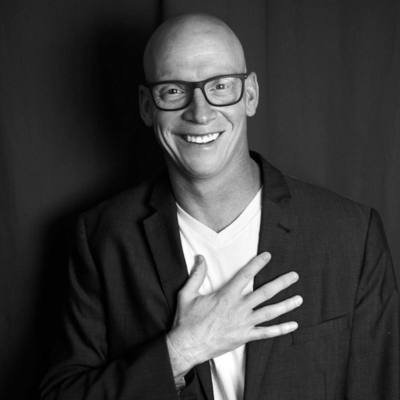
When I spoke with renowned breathwork pioneer Jon Paul Crimi, we started there — with some very honest and often funny observations about getting older. But our conversation soon moved into deeper territory: identity, addiction and sobriety, the emotions we learn to avoid, and the breathwork practice that has become the focus of Jon Paul’s work.
Sobriety and Learning to Feel Again
Jon Paul speaks openly about his early experiences with drugs and alcohol and the path that eventually led him to sobriety.
We talked about the way substances can begin as part of a completely normal social life and gradually become a way of managing what we don't know how to feel — grief, shame, anger, disappointment and pain.
When the substance disappears, those feelings don't necessarily disappear with it.
Sometimes they come roaring back.
Jon Paul describes the emotional work that sobriety can demand and why simply stopping drinking or using drugs isn't necessarily the end of recovery. The patterns underneath still need attention.
We also talked about the idea of the “high bottom” — when someone may appear perfectly functional from the outside but knows internally that their relationship with alcohol or drugs has become a problem.
Without the dramatic consequences we associate with addiction, it can be easier to convince ourselves that nothing really needs to change.
Jon Paul's experience is that recovery requires consistency, community and accountability. You have to keep doing the work.
The Power of Conscious Connected Breathwork
That idea of meeting what we've previously avoided leads naturally into the work Jon Paul is now best known for: breathwork.
Specifically, conscious connected breathing, sometimes called circular breathwork.
The inhale and exhale are connected without a pause, creating a continuous breathing rhythm. While breathwork has become enormously popular in recent years, Jon Paul has been working in this field for years and has witnessed what can happen when people move beyond thinking about their emotions and begin working directly with the body.
We explored why breathwork can have such a powerful effect on our internal state and why people use it when working with anxiety, grief, depression and difficult emotional experiences.
One of the concepts we discussed was transient hypofrontality — a temporary reduction in activity in areas of the prefrontal cortex. In simple terms, the part of the brain that wants to analyse, control and make sense of everything can become less dominant.
For anyone who spends a lot of time living in their head, that can create a very different experience.
Getting Through the First 10 Minutes
Jon Paul explained that the first 10 to 15 minutes of a breathwork session can often be the most challenging.
The brain likes familiarity.
When we deliberately change our breathing pattern, the mind may resist. The experience can feel uncomfortable, strange or intense, and there can be a very strong temptation to stop.
But staying with the breath can allow the experience to change.
Emotions may arise. Memories may surface. The body may respond in unexpected ways. And what emerges isn't always connected to the intention we brought into the session.
We can arrive wanting to work on one thing and discover that the body has something entirely different waiting for our attention.
What Happens in the Body?
We also got into some of the physiology behind conscious connected breathing.
Changing the way we breathe alters the balance of oxygen and carbon dioxide in the body. Breathing too intensely or over-exhaling can reduce carbon dioxide levels, which can contribute to sensations such as tingling, light-headedness or tetany — the involuntary tightening or cramping of the hands and other muscles that some people experience during breathwork.
This is one reason the quality of facilitation matters.
A skilled breathwork facilitator can help someone adjust the pace and intensity of their breathing rather than assuming that harder, faster or deeper is always better.
The aim isn't to force an experience.
It's to use the breath as a way of accessing what may be difficult to reach through thought alone.
Intention Versus What the Body Needs
Setting an intention before breathwork can provide a useful focus, but Jon Paul also talked about allowing the experience to unfold without trying to control it.
The body may surface what it needs rather than what the mind has decided it wants to explore.
That idea stayed with me.
We spend so much time trying to understand ourselves cognitively. We analyse our behaviour, tell ourselves stories about why we feel the way we do, and try to think our way through difficult experiences.
Breathwork offers another doorway.
Instead of asking the mind for another answer, we create enough space for the body to speak.
Making Breathwork Work in Real Life
Of course, having a transformative breathwork experience is one thing. Finding the time and privacy to actually do it when you have children, work and an ordinary busy household is another.
We talked about making the practice realistic.
Early morning can work well, particularly before eating and before the rest of the house gets moving. Headphones can help create a sense of privacy, and shorter sessions can make it easier to build consistency rather than waiting for the perfect opportunity to do a long session.
Integration matters too.
That might involve therapy, journalling or reflection. Sometimes, Jon Paul suggests, it can simply mean returning to the breath and allowing the process to continue in another session.
What Are We Using to Avoid Ourselves?
Perhaps the thread connecting Jon Paul's experiences of addiction, sobriety and breathwork is our very human tendency to avoid discomfort.
Alcohol and drugs are obvious ways of changing how we feel, but they're certainly not the only ones.
We can fill every spare moment with phones, social media, work, television, podcasts, news and endless information.
Jon Paul offered a wonderfully simple challenge: unsubscribe.
Notice what continually steals your attention and consider whether you still want to give it that much of your life.
Because creating space isn't only about having fewer things to do.
It gives us the opportunity to notice what's actually happening inside us.
Breathwork can be one way of entering that space — using something we carry with us every moment of our lives to reconnect with the body, process emotion and perhaps understand ourselves a little more deeply.
Sometimes the simplest tool is the one that's been with us all along.
Our breath.
This article was generated by AI from the original podcast transcript and edited for readability.